Serial tools
Interactive commands for sending raw bytes, computing CRCs, and inspecting serial data. These are REPL commands you type at the prompt -- no script files needed.
For automated send/expect test scripts, see Protocol Testing.
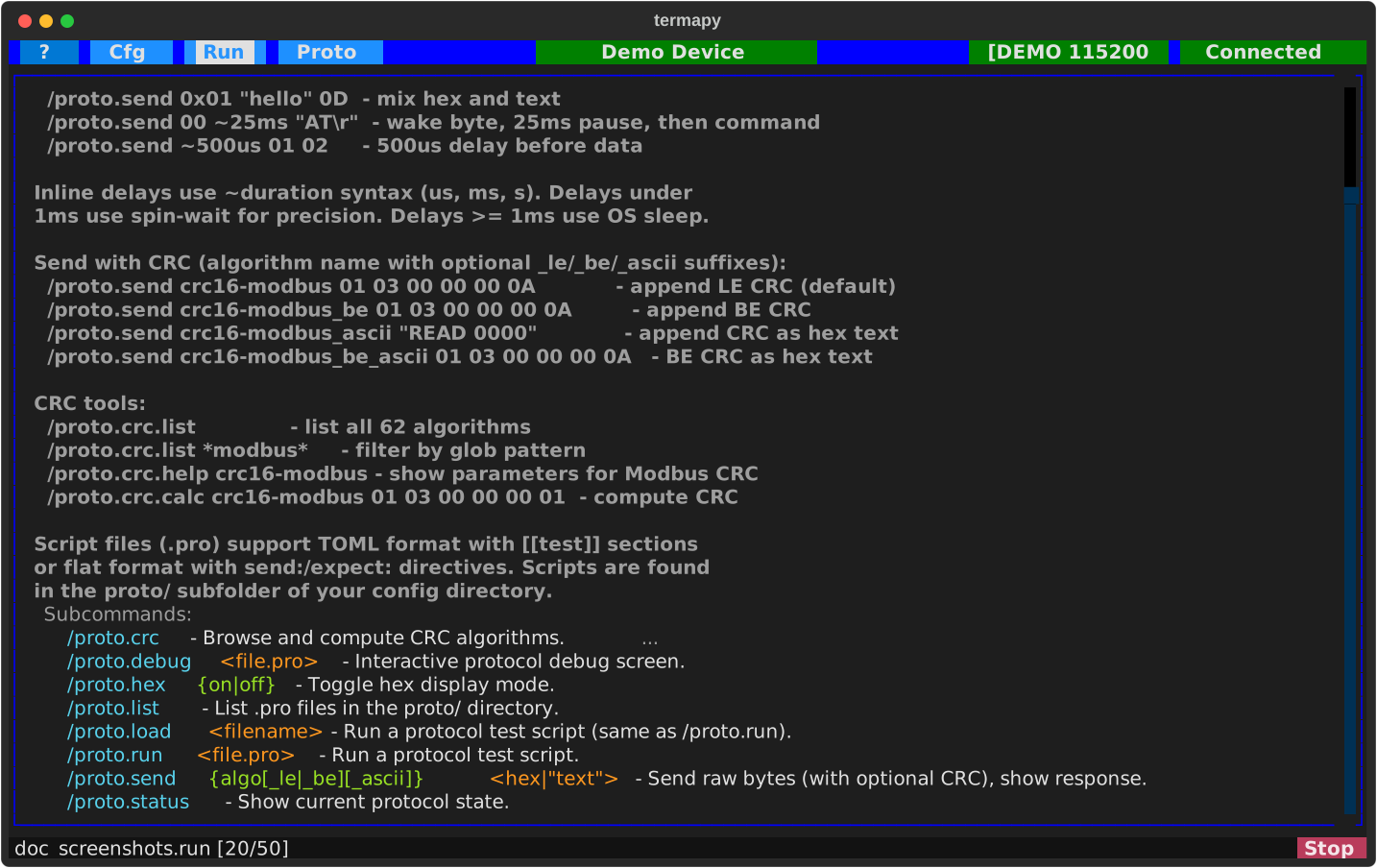
Send bytes
/proto.send transmits raw bytes and displays the response. No line ending
is appended -- you control exactly what goes on the wire.
Data formats
Hex bytes and quoted strings can be mixed freely:
/proto.send 01 03 00 00 00 0A           hex bytes
/proto.send "HELLO\r"                    quoted text (supports \r \n \t \0 \\)
/proto.send 02 "DATA" 03                mix hex and text
/proto.send 0x01 "hello" 0D             0x prefix is optional
Inline delays
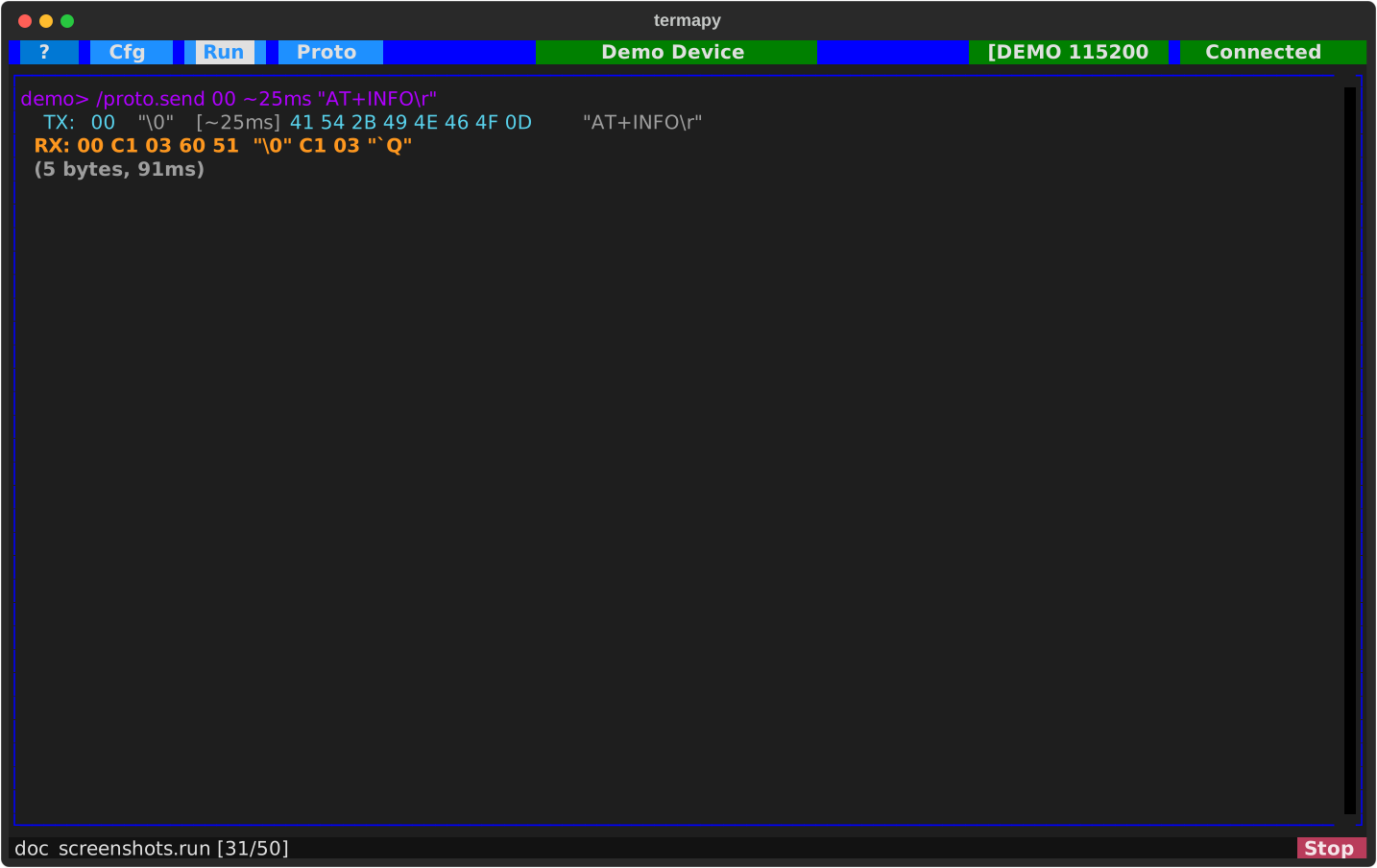
Insert timing gaps with ~duration between data segments:
/proto.send 00 ~25ms "AT\r"             wake byte, 25ms pause, then command
/proto.send "\r" ~5ms "AT+INFO\r"       CR to wake, 5ms settle, then query
/proto.send ~500us 01 02 03             delay before first byte
Supported units: us (microseconds), ms (milliseconds), s (seconds).
Timing precision: delays under 1ms use a spin-wait loop for accuracy. Delays >= 1ms use OS sleep. Sub- 2 millisecond delays are best-effort due to USB frame timing (~1ms boundaries on Full Speed USB).
CRC append
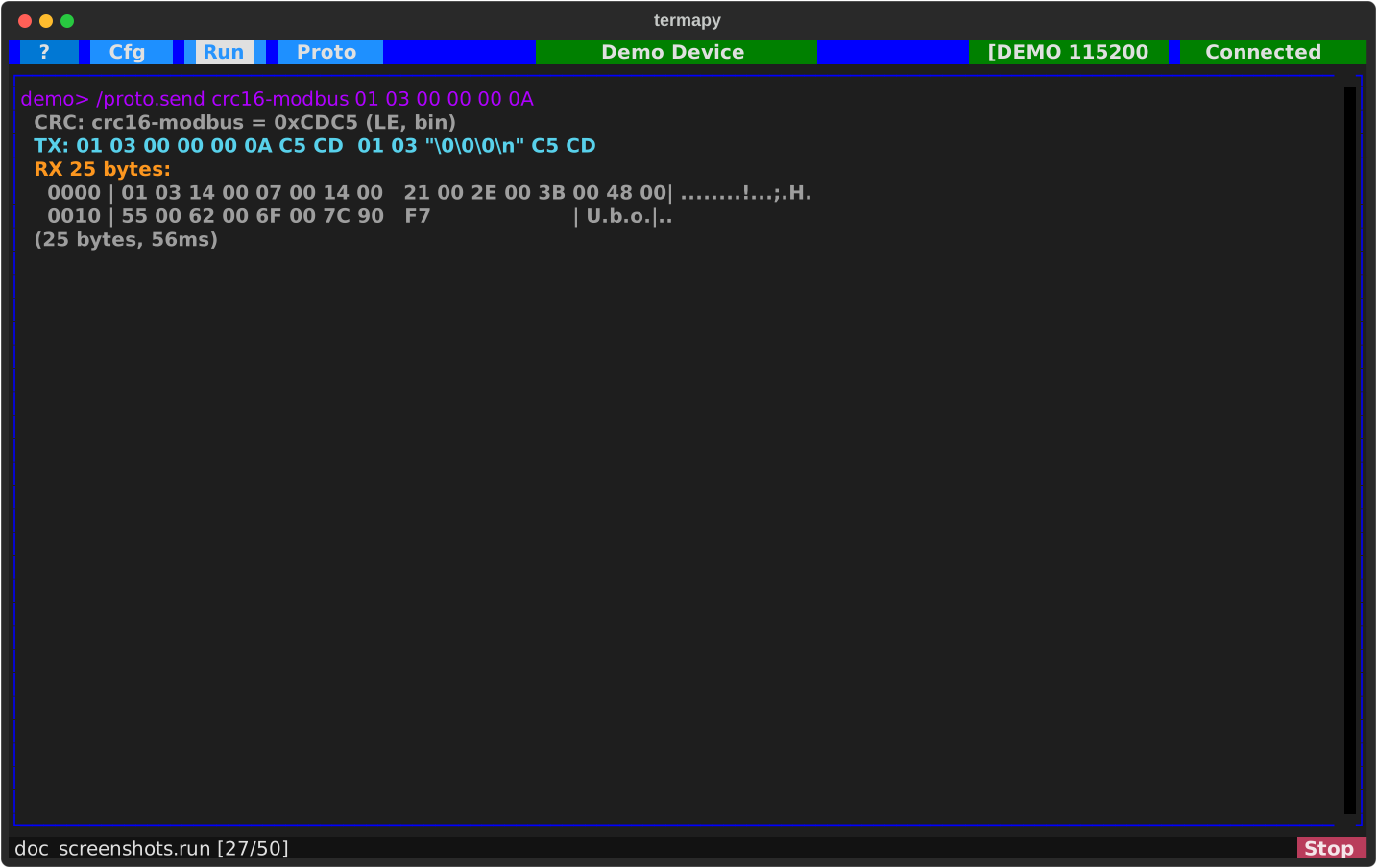
If the first word matches a CRC algorithm name, the CRC is computed over the data and appended automatically:
/proto.send crc16-modbus 01 03 00 00 00 0A      append Modbus CRC (LE)
/proto.send crc16-modbus_be 01 03 00 00 00 0A   big-endian CRC
/proto.send crc16-modbus_ascii 01 03 00 00 00 0A CRC as hex text (e.g. "C5CD")
Suffixes: _le (little-endian, default), _be (big-endian), _ascii
(CRC appended as hex text instead of binary bytes).
When combined with delays, CRC is computed on all data bytes concatenated (delays are excluded from the CRC calculation).
Response display
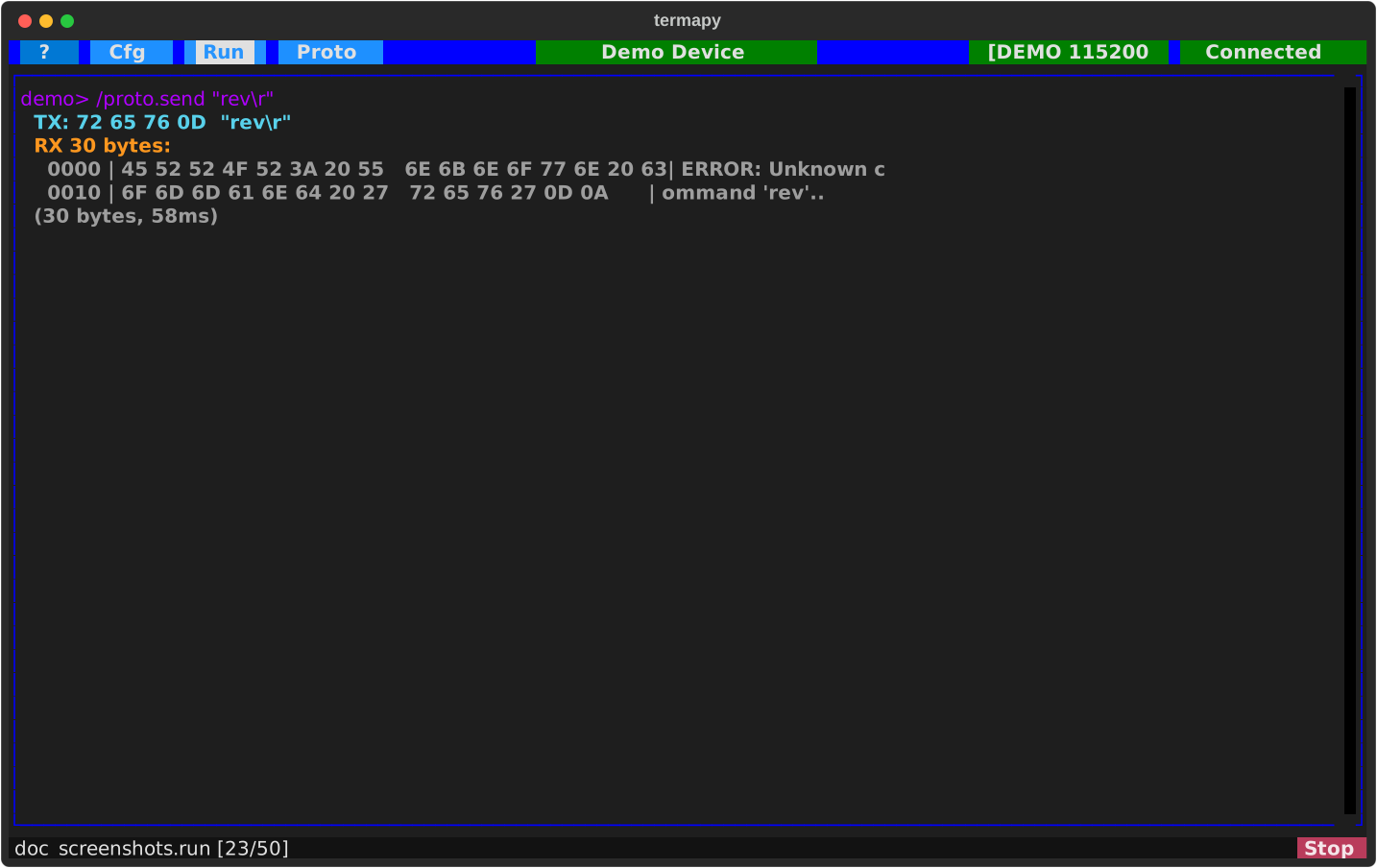
Both TX and RX show hex bytes and a smart text representation:
Packets longer than 16 bytes use a multi-line hex dump with ASCII sidebar. Round-trip timing includes all inline delays.
Hex display mode
Toggle hex display for all serial I/O with /proto.hex on / /proto.hex off.
CRC algorithms
Every named CRC algorithm in termapy comes from the reveng CRC
catalog
maintained by Greg Cook. That catalog documents the polynomial,
init, reflection, and xor-out parameters for every standardized CRC
in practical use, and our test suite verifies each one against its
published check value on every commit.
More than 100 algorithms are built in covering the CRC-8, CRC-16, CRC-32, and CRC-64 families (Modbus, XMODEM, CCITT, USB, and more).
REPL commands:
/proto.crc.list- show all available algorithms/proto.crc.list *modbus*- filter by pattern/proto.crc.info crc16-modbus- show algorithm parameters/proto.crc.calc crc16-modbus 01 03 00 00 00 0A- compute CRC/proto.crc.find bin=01 03 00 00 00 0A C5 CD- identify the algorithm used in a captured packet
Choosing a CRC for speed
If you're designing a protocol and free to pick the CRC (not matching
an existing device), prefer CRC-32 (crc32) or CRC-32C
(crc32-iscsi, Castagnoli) -- especially when large payloads or
high-throughput streams need checking.
Modern CPUs have hardware support for these polynomials: the SSE4.2
crc32 instruction and PCLMULQDQ on x86, the CRC32 instructions on
ARM. Code that uses them (zlib for IEEE CRC-32, hardware intrinsics for
CRC-32C) runs roughly 10x faster than a software CRC of an arbitrary
polynomial. An obscure CRC-16 has no hardware path -- it's computed
bit-by-bit or table-driven in software regardless.
This only applies when the choice is yours. If the device already speaks CRC-16/Modbus, you speak CRC-16/Modbus.
Identifying a CRC from a captured packet
/proto.crc.find takes the full packet you captured and figures out
which catalog algorithm produced its CRC. Three input forms:
bin=<hex bytes>-- raw binary packet. The last 1 / 2 / 4 bytes are tried as the CRC field; both big- and little-endian are attempted.asc=<text>-- ASCII packet with a trailing hex-encoded CRC (common in NMEA-style protocols). The last 2 / 4 / 8 characters are parsed as hex.cmd=<trigger>-- send a trigger command to the connected device, capture its reply, and identify the CRC in that.
Optional filters narrow the search: width=8|16|32|64, endian=be|le,
and form=NAME for a packet wrapped in a named framing. Every match
reports the algorithm name, field width, byte order, and the length of
the preceding data, one line per match:
> /proto.crc.find bin=31 32 33 34 35 36 37 38 39 37 4B
  crc16-modbus  width=16  field=last2  endian=little  data=9 bytes
For a whole batch of frames at once, /proto.crc.detect <frames>...
takes several packets and reports only the algorithms that fit all of
them; /proto.crc.verify checks one frame against a named algorithm.
Limits:
- The search only covers the reveng catalog. A custom CRC with a
non-standard poly / init / refin / refout / xorout will not match --
the parameter space is ~10^15 for 16-bit, so brute force is not
tractable. For those,
/proto.crc.reverserecovers the Rocksoft parameters algebraically (the approach from Greg Cook's reveng project): give it two or more captured packets as hex, orcmd=<trigger> count=<N>to capture them from the device. - The tool assumes the CRC field is at the end of the packet. Protocols with the CRC in the middle or as a non-contiguous checksum require a different approach.
- Multiple matches usually mean the packet is too short to disambiguate. Capture a second packet with a different CRC and run find again; the intersection narrows the candidates.
Algorithm names are the reveng catalog names (crc16-modbus,
crc16-xmodem, crc32, ...); /proto.crc.list shows them all.
In format specs and /proto.send, CRC algorithm names accept suffixes:
_le (little-endian, default), _be (big-endian), _ascii (hex text).
CRC code generation
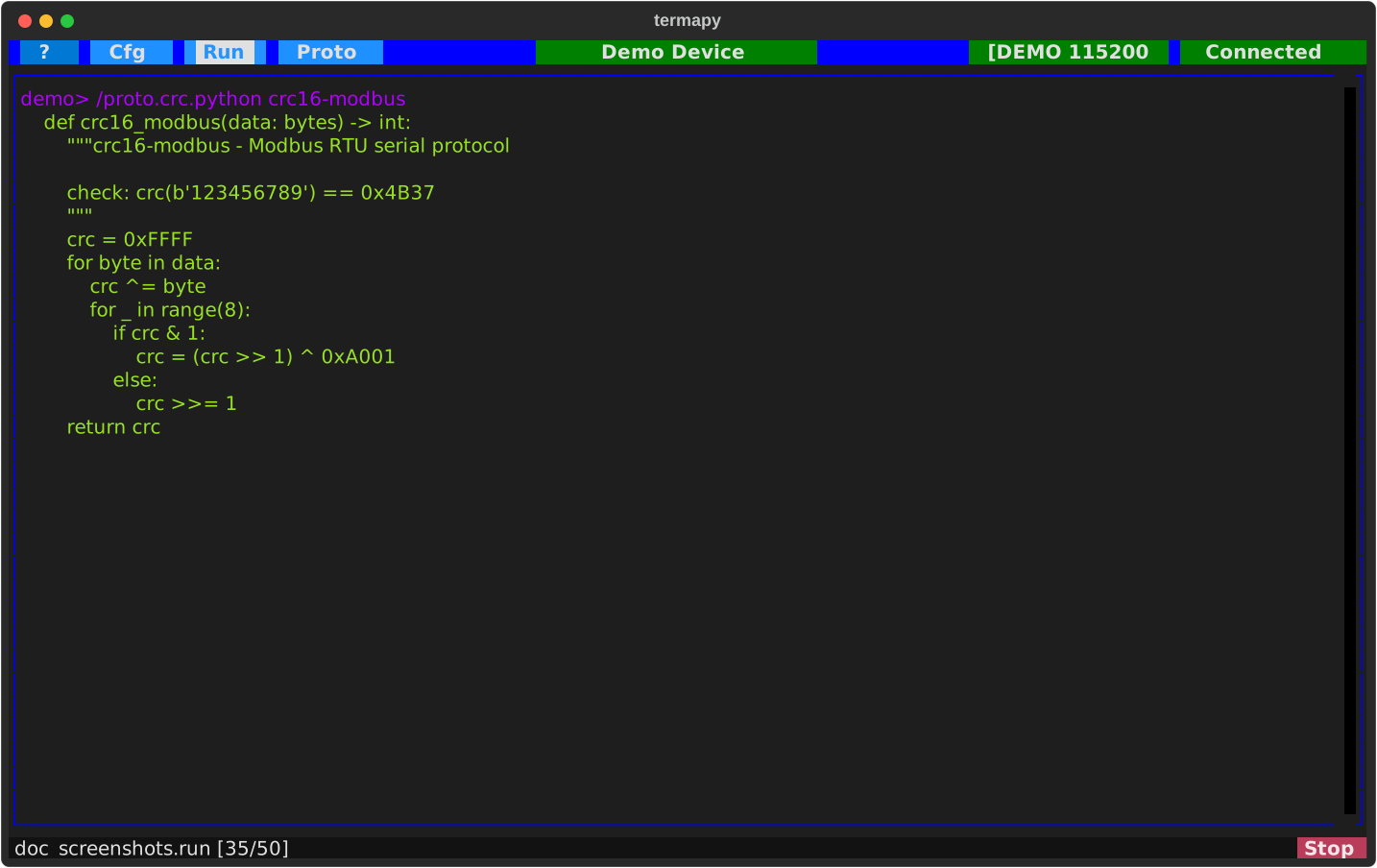
Generate a standalone CRC function for any algorithm in the catalog,
in C, C#, Go, Java, Lua, Python, Rust, TypeScript, Verilog, VHDL, or
Zig (/proto.crc.<language>). The bare command emits the fastest
variant the language and width support; flags pin a variant:
/proto.crc.python crc16-modbus           fastest for this language (default)
/proto.crc.python crc16-modbus --small   bit-by-bit (small, no tables)
/proto.crc.c crc16-xmodem --table        table-driven (256-entry lookup)
/proto.crc.c crc32 --slice8              slice-by-8 (CRC-32/64 only)
/proto.crc.rust crc64-xz                 Rust, fastest variant
/proto.crc.c crc16-modbus crc32 file=my_crcs   several algorithms into one file
file=STEM writes the source to a file instead of the screen,
symbol=NAME renames the generated function, and style=NAME /
naming=NAME pick the doc-comment and identifier conventions
(/help proto.crc.<language> lists the values).
Bit-by-bit -- compact code, zero RAM overhead. Best for microcontrollers with limited memory (PIC, ATtiny).
Table-driven (--table) -- 4-8x faster. Pre-computes a
256-entry lookup table. Uses 256-1024 bytes of RAM depending
on CRC width.
Slice-by-8 (--slice8) -- 5-10x faster than --table for
CRC-32 and CRC-64 on large buffers. Pre-computes 8 lookup tables
(8 KB at width 32, 16 KB at width 64) and consumes 8 bytes per
loop iteration. C and Rust only; width 32 or 64 only.
(/proto.crc.python ... --slice8 is accepted but falls back to
--table -- slice-by-8 in CPython is actually slower than plain
table-driven because PyLong allocations eat the loop-iteration
savings. The fallback prints a note so you know.)
All algorithm parameters (polynomial, init, reflect, xorout) are baked into the generated code. Copy-paste into your firmware or test script.
Example: bit-by-bit vs table-driven
For /proto.crc.python crc16-cms:
def crc16_cms(data: bytes) -> int:
    """crc16-cms - CMS (RPM package format)

    check: crc(b'123456789') == 0xAEE7
    """
    crc = 0xFFFF
    for byte in data:
        crc ^= byte << 8
        for _ in range(8):
            if crc & 0x8000:
                crc = (crc << 1) ^ 0x8005
            else:
                crc <<= 1
            crc &= 0xFFFF
    return crc
And /proto.crc.python crc16-cms --table:
_TABLE = (
    0x0000, 0x8005, 0x800F, 0x000A, 0x801B, 0x001E, 0x0014, 0x8011,
    # ... 248 more entries ...
)

def crc16_cms(data: bytes) -> int:
    """crc16-cms - CMS (RPM package format)

    check: crc(b'123456789') == 0xAEE7
    """
    crc = 0xFFFF
    for byte in data:
        crc = _TABLE[((crc >> 8) ^ byte) & 0xFF] ^ (crc << 8) & 0xFFFF
    return crc
Both forms return 0xAEE7 for b"123456789" -- the docstring shows the
catalog check value so you can verify after pasting.
Verification: we test the Python; you verify everything else on your target
For the Python generator, our test suite execs every output and
asserts the canonical reveng check value (crc("123456789")). Same
interpreter you use, so if our tests pass, your import works.
For the C, Rust, and VHDL generators, we test on our development machines (compile + run + check), but the contract for using our generated code is that you verify on your own build environment before shipping -- your compiler version, your target ISA, your simulator, your optimization flags may differ from ours. Every generated file embeds the test for exactly this purpose:
| Language | How to verify |
|---|---|
| C | Call <fname>_self_test() from your main() or test framework. Returns 0 on success, 1 on failure. No main() is emitted, so it links cleanly alongside your own. |
| Rust | cargo test (or rustc --test) runs the embedded #[cfg(test)] mod tests block, which asserts the check value. Exit 0 means pass. |
| VHDL | Call <fname>_self_test (returns boolean) from a testbench process via assert <fname>_self_test severity failure;. Halts simulation on failure. |
| Python | No separate test needed -- the generator runs the same interpreter you do, and our test suite execs every output. If import succeeds, the implementation matches the catalog check value (which the docstring lists, e.g. check: crc(b'123456789') == 0xCBF43926). |
Every generated file's self-test compares crc("123456789") against the
reveng-catalog canonical check value, baked into the source at emit time. If
your compiler or target produces a different value, the self-test catches
it -- you have an immediate, decisive signal that something in your build
environment differs from ours, before the CRC ships into firmware.
What's in the box (and what you can drop for embedded)
Each generated file ships with five entry points: a streaming triple
(init / update / finalize), a one-shot wrapper that composes them,
and a self-test. Pick the shape that fits your call site -- a firmware
that computes the CRC over a whole frame at once uses the one-shot;
a streaming protocol that processes bytes as they arrive uses the triple.
| Function | Use case | Safe to drop? |
|---|---|---|
<fname>_init / _update / _finalize |
Streaming -- feed data chunk by chunk | No (the one-shot wrapper calls them internally) |
<fname> (one-shot wrapper) |
Whole-buffer computation in a single call | Yes, if you only stream |
<fname>_self_test |
One-time toolchain verification (above) | Yes, after you've verified once |
For memory-constrained embedded targets, the standard toolchain flags strip unreferenced functions automatically -- no manual edits to the generated source needed:
- C -- compile with
-ffunction-sections -fdata-sections, link with-Wl,--gc-sections. Any function your code doesn't call (transitively) drops out of the final binary. - Rust --
cargo --releasedrops the#[cfg(test)] mod testsblock automatically; enabling LTO (-C lto=fator[profile.release] lto = true) drops other unused functions. - VHDL -- synthesizers (Vivado, Quartus, Intel Quartus Prime, etc.) elaborate only what's referenced from the top-level entity. Unused package functions cost zero gates.
- Python -- not applicable (interpreted; "removing" a function just saves source bytes, not RAM).
So an embedded firmware that calls crc32(data, len) once per packet
and has run _self_test() once at boot can compile-and-strip down to
just _init + _update + _finalize + crc32 in the final binary,
with no self-test overhead and no streaming-vs-one-shot duplication.
Custom CRC plugins for non-standard checksums: